


State argues blanket prohibition goes beyond legal framework and contradicts existing statutes permitting slaughter of aged or incapacitated cattle under certain conditions
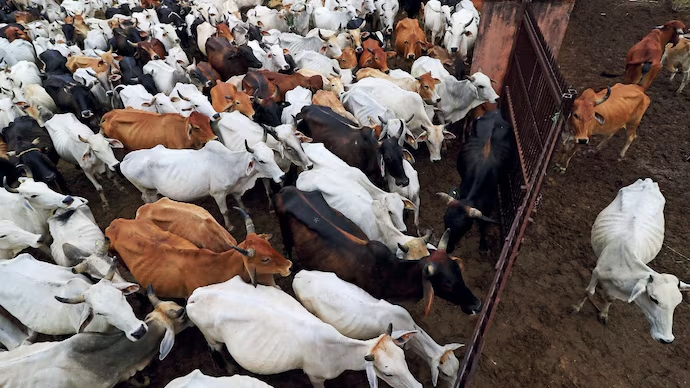
The Tamil Nadu government has moved the Supreme Court challenging a Madras High Court order imposing a complete ban on cow slaughter across the state, arguing that the directive exceeds the scope of the law and results in an internally contradictory judgment .
The High Court’s May 27 order, passed by a division bench of Justices G.R. Swaminathan and V. Lakshminarayanan, directed the Chief Secretary and Director General of Police to ensure that no cow or calf is slaughtered in Tamil Nadu either on Bakrid “or on any other day” . The ruling relied on a 1976 Government Order banning cow slaughter in the interest of milk production and rural economy, as well as Article 48 of the Constitution, which urges the state to prohibit the slaughter of cows, calves and other milch and draught cattle .
State’s objections to the High Court ruling
In its Special Leave Petition, the state government has raised several objections to the High Court’s directive. First, it contends that the order contradicts the Tamil Nadu Animal Preservation Act, 1958, which permits the slaughter of cows over 10 years of age that are unfit for work or breeding, subject to certification by the competent authority . The state argues that by directing a complete prohibition, the High Court has effectively substituted judicial legislation for statutory law .
The state also objects to the High Court relying upon a 1976 Government Order whose validity or applicability was never in issue before the court, arguing that an executive instruction cannot override or supersede statutory enactments governing animal slaughter in Tamil Nadu .
Relief granted beyond petitioner’s prayer
According to the state government, the original writ petition was narrowly confined to preventing the slaughter of cows in public places during Bakrid in Coimbatore . However, the Division Bench expanded the issue to impose what the government describes as an “absolute and blanket ban” on cow slaughter even in designated slaughterhouses, despite no such relief having been sought by the petitioner . “A relief, which was neither pleaded nor prayed, was granted,” the state contended .
The government further argues that the High Court’s order is internally contradictory. While one part of the judgment correctly observes that animal slaughter can take place only in designated slaughterhouses, it simultaneously directs that no cow or calf should be slaughtered on Bakrid or any other day . “This results in an internally contradictory judgment,” the state argued .
Basis of the High Court’s order
The Madras High Court had passed the order while allowing a public interest litigation petition filed by K. Surya alias K. Surya Prasanth, youth wing secretary of Indu Makkal Katchi, who alleged that temporary sheds had been erected at several locations in Coimbatore for the slaughter of cows during Bakrid .
In its ruling, the court cited Supreme Court judgments holding that cow slaughter during Bakrid is not an essential religious practice in Islam . “The Hon’ble Supreme Court observed that many Muslims do not sacrifice cows on BakrI’d day. Sacrifice of a cow on that day is not an obligatory overt act for a Musalman to exhibit his religious belief and idea,” the bench noted .
The court also observed that under the Tamil Nadu Urban Local Bodies Rules, 2023, animals such as goats and sheep can only be slaughtered in licensed slaughterhouses and not in temporary or unauthorised facilities . “Since the executive power is co-terminus with the legislative power, a Government Order issued by the Government banning cow slaughter is very much sustainable and has to be enforced, as it has the force of law,” the court stated .
Next steps
According to the Supreme Court website, the state’s petition was filed on June 9 and is currently on the defect list for correcting filing defects . The petition has been filed by the state’s standing counsel, Jayashree Narasimhan, as Advocate-on-Record .