


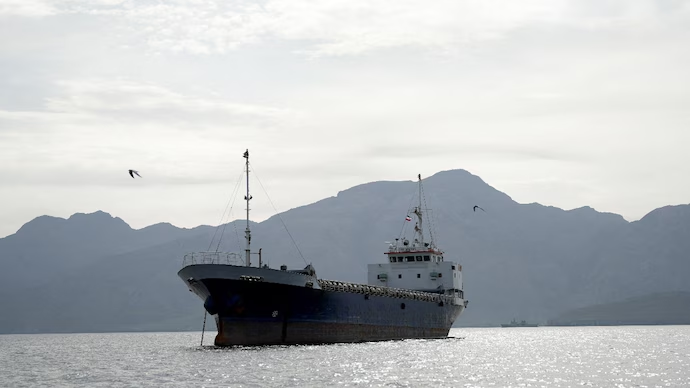
Diplomacy has run its course, at least for now. After US Vice-President JD Vance’s negotiations with Iran failed to produce a breakthrough on Saturday, President Donald Trump has ordered a naval blockade targeting vessels entering or leaving the Strait of Hormuz.
In a series of posts on Truth Social on Sunday, Trump wrote: “No one who pays an illegal toll will have safe passage on the high seas.” According to his announcement, the blockade took effect at 10 am ET (7:30 pm India time).
The Blockade: Key Details
| Action | Naval blockade of Iranian ports in the Strait of Hormuz |
| Effective Date | April 13, 2026 (10 am ET / 7:30 pm IST) |
| Scope | All vessels entering or exiting Iranian ports |
| Enforcement | US Central Command (CENTCOM) |
| Warning | Ships could face interception or capture if they violate the order |
The US Central Command (CENTCOM) said the Hormuz blockade will apply to all vessels entering or exiting Iranian ports. In a statement, CENTCOM said it will be “enforced impartially against vessels of all nations” using Iranian ports and coastal areas, including those along the Arabian Gulf and the Gulf of Oman.
Trump’s Warning to Iran’s Navy
In a separate post, Trump warned: “Iran’s Navy is laying at the bottom of the sea, completely obliterated – 158 ships. What we have not hit are their small number of, what they call, ‘fast attack ships,’ because we did not consider them much of a threat.”
“Warning: If any of these ships come anywhere close to our BLOCKADE, they will be immediately ELIMINATED, using the same system of kill that we use against the drug dealers on boats at Sea. It is quick and brutal.”
Why Diplomacy Failed
The blockade follows the collapse of nearly 20-hour-long talks in Islamabad, led by US Vice-President JD Vance. While Trump claimed progress had been made, he maintained that Iran refused to give up its nuclear ambitions, which was the core sticking point.
| Nuclear Enrichment | Iran refuses to give up its nuclear ambitions |
| Control of Hormuz | Disagreement over Iran’s control of the strait |
| Regional Support | Iran’s support for Hezbollah and Houthis |
| Sanctions Relief | How much relief Tehran should receive |
The disagreements go well beyond the nuclear issue. They also cover Iran’s control over the Strait of Hormuz, its support for groups like Hezbollah in Lebanon and the Houthis in Yemen, uranium enrichment limits, the fate of Iran’s existing stockpile, and sanctions relief.
Mediators Working Behind the Scenes
However, mediators from Pakistan, Egypt, and Turkey are working behind the scenes to revive talks.
“We are not in a complete deadlock. The door is not closed yet. Both sides are bargaining. It’s a bazaar,” a regional source told Axios, highlighting that negotiations remain alive, even if fragile.
Economic Impact: Oil Prices Surge Past $100
The impact of the blockade is already visible. Oil prices have surged past $100 a barrel again, and global markets have shown signs of strain as uncertainty deepens over passage of vessels through the Strait of Hormuz.
- Oil Prices: Surged past $100/barrel
- Shipping Activity: Choked since conflict escalated in February
- US Political Risk: CBS poll shows 59% of Americans believe conflict is not going well
Iran’s Response
Iran’s Revolutionary Guards (IRGC) said the strait remains under their full control, warning that any “erroneous” move by US or allied forces could have serious consequences.
“Any erroneous maneuver will trap the enemy in deadly whirlpools in the strait,” the IRGC Navy said.
Iranian leaders have also mocked the economic fallout of US actions. Parliament Speaker Mohammad Bagher Ghalibaf shared an image of petrol prices near the White House, warning that current rates may soon seem like a bargain.
“Enjoy the current pump figures,” he wrote, warning that American citizens could grow “nostalgic” for $4-$5 per gallon fuel if tensions continue to escalate.
The Core Dilemma
Washington’s core dilemma remains the same. The blockade may put pressure on Iran, but it also risks unsettling global markets and pulling the US deeper into a conflict that could drag on, given that Iran has shown no signs of lowering its guard or willingness to concede on nuclear enrichment and control of the Strait of Hormuz.