


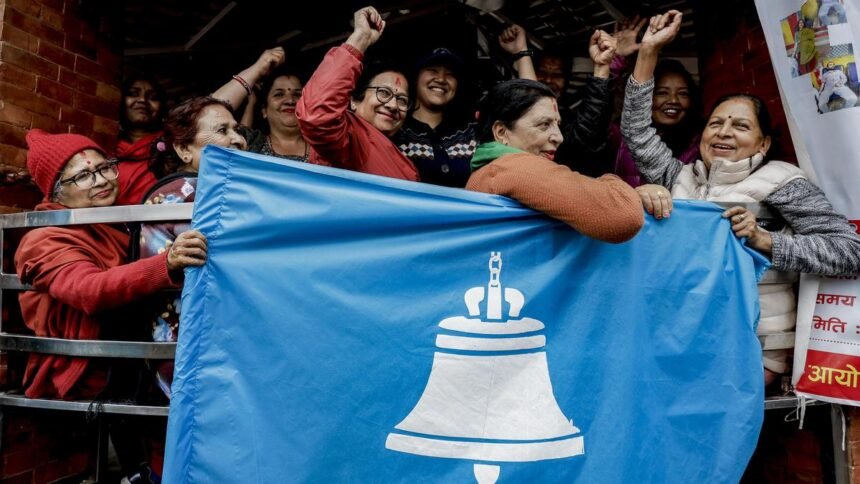
KATHMANDU: In a seismic shift that has redefined Nepal’s political landscape, the four-year-old Rastriya Swatantra Party (RSP) — symbolized by the humble bell — has secured a stunning, landslide victory in the March 5, 2026, general elections. Campaigning on a fiery anti-corruption and anti-establishment platform, the party has dealt a crushing blow to the country’s traditional political giants.
The Rise of a New Force
The RSP’s journey from a fledgling experiment to a formidable political powerhouse is a story of strategic evolution, charismatic leadership, and a public mood fed up with the old guard.
| Timeline | Key Event |
|---|---|
| June 2022 | Rabi Lamichhane, a popular TV talk show host known for confronting politicians, founds the RSP. |
| Nov 2022 | In its first election, the party finishes a surprising fourth. |
| 2022-2024 | RSP joins the government twice; Lamichhane faces legal battles and brief jail terms over cooperative fund embezzlement charges, denting the party’s image. |
| July 2024 | Pushed into opposition after Nepali Congress and CPN-UML form a coalition. |
| Sept 2024 | RSP supports massive Gen Z protests against corruption and misrule. The protests turn deadly (77 killed, including 19 in police firing) and ultimately topple the Oli government. |
| Dec 2024 | Popular Kathmandu Mayor Balendra Shah (“Balen”) joins RSP as its prime ministerial candidate. |
| March 5, 2026 | RSP wins a historic landslide in the snap elections. |
The Architects of Victory: Rabi and Balen
The RSP’s success is built on two distinct, powerful personalities.
- Rabi Lamichhane: The founder and original face of the party. His confrontational journalism built a brand of anti-establishment credibility. Despite his legal troubles, which the party frames as political vendettas, he remains a symbol of fighting the system.
- Balendra Shah (Balen): The popular Kathmandu Mayor. His entry into the RSP as the prime ministerial candidate was a game-changer. The election became, in many ways, a referendum on Balen, with his popularity transcending party lines. Analysts dubbed it the ‘Balen effect’ , which propelled the RSP to victory.
The Scale of the Victory
The RSP’s performance has not just been a win; it has been a political earthquake.
| Metric | RSP’s Performance |
|---|---|
| Projected Total Seats | On track for a majority (138 seats) , potentially reaching a two-thirds majority (184) in the 275-member House. |
| FPTP Seats | Won 57 seats; leading in 64 out of 165 constituencies. |
| Proportional Vote Share | Leading with a staggering 53% vote share. |
| Key Defeats | Balen is set to defeat former PM K.P. Sharma Oli. Congress leader Gagan Thapa is trailing in Sarlahi-4. |
What Drove the Mandate?
- Anti-Incumbency and Corruption: Years of public frustration with the Nepali Congress, CPN-UML, and Maoist Centre boiled over. The RSP successfully channeled this anger.
- The Gen Z Protests: The deadly September 2024 protests, which the RSP supported, created a clear dividing line between the party of change and the establishment seen as responsible for the crackdown.
- Ideological Clarity: The RSP evolved from a personality-centric outfit to a party with a clearer identity: a “pluralistic democratic party” with a “centrist liberal” economic outlook, appealing to a broad electorate.
- The Balen Factor: The mayor’s immense personal popularity, particularly among urban and younger voters, gave the party a face that was fresh, incorruptible, and distinct from traditional politicians.
What Comes Next?
The RSP’s victory marks the end of an era dominated by the Congress-UML-Maoist trio and the beginning of a new, uncertain chapter in Nepali politics. The party, once criticized for lacking ideology, now has a powerful mandate to implement its anti-corruption agenda and define its vision for Nepal’s governance and federal structure. As economist Swarnim Wagle, an RSP leader, predicted in 2023, the “movement in the making” has indeed emerged as the major political force.