


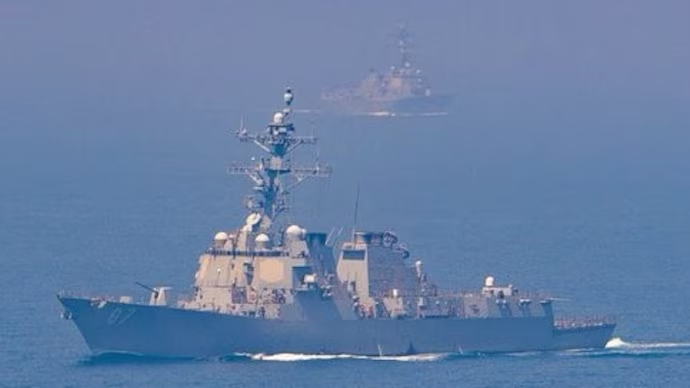
In the sharpest confrontation since the fragile US-Iran ceasefire came into effect on April 7, the two sides exchanged fire and accused each other of carrying out attacks near the Strait of Hormuz. The fresh military actions come as Tehran was weighing a proposal aimed at ending the conflict.
On Thursday, the US Central Command said American forces struck Iranian military facilities that were allegedly used to launch attacks on warships transiting the vital waterway.
The Exchange of Fire
| Aspect | US Position | Iranian Position |
|---|---|---|
| Nature of Strikes | Defensive; direct response to Iranian attack | US targeted civilian areas |
| Targets | Iranian military facilities | Iranian territory and two ships entering Hormuz |
| Casualties | US destroyed Iranian attackers (per Trump) | Air defence systems activated in Tehran |
The US military maintained that the strikes were defensive in nature and stressed that Washington did “not seek escalation.” It also maintained that its actions were a direct response to the Iranian attack.
Iran, however, accused the US of targeting civilian areas during the airstrikes. A spokesperson for Iran’s armed forces claimed the strikes hit Iranian territory and also targeted two ships entering Hormuz.
Iranian state-linked media also reported that air defence systems were activated in Tehran following the escalation, intensifying fears of a broader military crisis in the region.
Trump’s Response
| Quote | Context |
|---|---|
| “We’ll knock them out a lot harder, and a lot more violently” | Warning if Iran does not agree to a deal soon |
| “It’s just a love tap” | Downplaying the confrontation to an ABC reporter |
| Ceasefire remains in effect | Despite the exchange of fire |
Speaking to reporters, President Donald Trump claimed American forces had destroyed the Iranian attackers and warned Tehran against further provocations.
He accused Iran of having “trifled with us.” Despite the exchange of fire, both Washington and Tehran signaled that they were not seeking a wider conflict.
The Diplomatic Context
| Aspect | Details |
|---|---|
| Current Status | Washington awaiting Tehran’s response to a proposed framework |
| Proposal | Three-stage process: formal ceasefire, Hormuz tensions, 30-day negotiation |
| Contentious Issues Avoided | Nuclear activities, unrestricted navigation through Hormuz |
| Iran’s Position | No final decision reached yet |
The latest violence came as Washington awaited Tehran’s response to a proposed framework intended to formally end the war and stabilise the Gulf region.
According to reports, the proposal outlines a three-stage process involving a formal ceasefire, measures to resolve tensions in the Strait of Hormuz, and a 30-day negotiation period for a broader long-term agreement.
However, the proposal reportedly avoids several contentious issues, including key US demands that Iran curb its nuclear activities and guarantee unrestricted navigation through the Strait of Hormuz.
Strategic Importance of the Strait of Hormuz
| Aspect | Details |
|---|---|
| Global Oil Supply | Previously handled nearly one-fifth of the world’s oil and gas |
| Current Risk | Instability threatens international shipping and energy supplies |
| Market Impact | Flare-up raised concerns among regional allies and global markets |
The waterway previously handled nearly one-fifth of the world’s oil and gas supplies, making any instability there a major concern for international markets.
What’s Next
Iran’s foreign ministry said Tehran had not yet reached a final decision on the proposal, underscoring continued uncertainty over whether diplomacy can prevent further conflict.
Iranian authorities later said the situation had returned to normal, while the US reiterated that it did not want escalation in the region.