


In a stunning revelation, China has for the first time confirmed that it provided on-site technical support to Pakistan during Operation Sindoor — India’s retaliatory military strike against terror hideouts in Pakistan and PoK in May 2025.
The disclosure comes as India marks the first anniversary of Operation Sindoor. The acknowledgment was made by Chinese engineers themselves in an interview with Chinese state broadcaster CCTV, marking the first official acceptance that Chinese personnel were involved in the four-day mini-war with India.
What Did the Chinese Engineers Say?
Two engineers from the Aviation Industry Corporation of China’s (AVIC) Chengdu Aircraft Design and Research Institute — Zhang Heng and Xu Da — revealed the extent of China-Pakistan military cooperation during the 2025 conflict.
Zhang Heng’s Statement
Zhang Heng told CCTV:
*”At the support base, we frequently heard the roar of fighter jets taking off and the constant wail of air-raid sirens. By late morning, in May, the temperature was already approaching 50 degrees Celsius. It was a real ordeal for us, both mentally and physically.”*
He added that his team was driven by the “desire to do an even better job with on-site support” and ensuring their equipment could “truly perform at its full combat potential.”
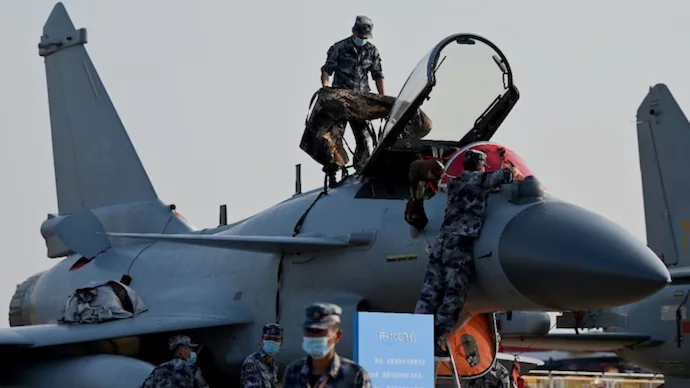
Zhang was specifically referring to the J-10CE fighter jet — the export version of China’s advanced J-10C 4.5-generation fighter.
Xu Da’s Emotional Statement
Xu Da, another engineer from the same institute, emotionally likened the J-10CE fighter to a “child” :
“We nurtured it, cared for it, and finally handed it over to the user. And now, it was facing a major test.”
Which Chinese Fighter Jet Was Used by Pakistan?
| Aircraft | Details |
|---|---|
| J-10CE | Export version of J-10C (4.5-generation) |
| Manufacturer | Chengdu Aircraft Industry Group (CAIG) – AVIC subsidiary |
| Key Features | AESA radar, PL-15 air-to-air missiles |
| Operator | Pakistan is the only known operator outside China |
The PL-15 missile — which is compatible with the J-10CE — was also used by Pakistan during Operation Sindoor against India.
What This Means for India-China-Pakistan Dynamics
1. Deepening China-Pakistan Military Nexus
This is the first official confirmation that Chinese technical personnel were directly involved in supporting Pakistan during an active conflict with India.
Senior defence officials have previously stated that Beijing supported Pakistan not only with military hardware, but also through intelligence sharing and satellite imagery.
2. Pakistan as China’s Testing Ground
The revelation shows how Pakistan has effectively become a real-world testing ground for Chinese military technology under combat conditions.
3. Future Implications for India
For India, this underlines that any future confrontation with Pakistan might increasingly involve:
- Chinese-made weapons systems
- Chinese intelligence support
- Chinese technical coordination working in tandem
4. Military Dependency Data
According to SIPRI data, Pakistan has imported over 80% of its military equipment from China in the last five years.
Background: What Was Operation Sindoor?
Operation Sindoor was India’s retaliatory military operation conducted in May 2025 against terror hideouts in Pakistan and Pakistan-occupied Kashmir (PoK).
- Duration: Four days
- Nature: Mini-war between India and Pakistan
- Indian objective: Strike on terror infrastructure
The operation was widely covered as a significant military escalation between the two nuclear-armed neighbors.
Reaction from Indian Defence Establishment
While official reaction from the Indian government is still awaited, defence analysts have expressed concern over China’s direct technical involvement.
Former military officials point out that China has long armed and supported Pakistan militarily, but the presence of Chinese engineers providing on-site assistance during an active conflict marks a deeper level of operational integration.