


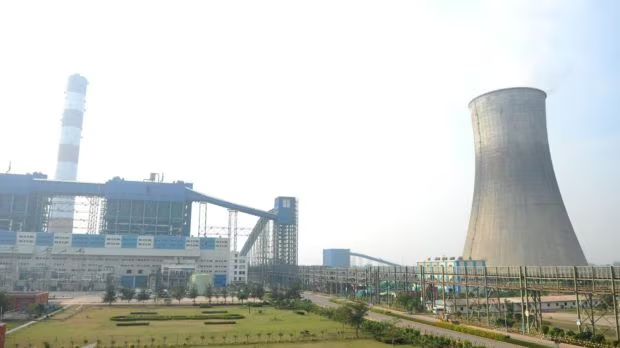
In a significant move to repurpose ageing coal-fired power infrastructure, a government panel has shortlisted at least three old thermal power plant sites for setting up new nuclear power projects.
Of the three shortlisted sites, two have been found suitable for large nuclear reactors of 700 megawatt-electric (MWe) capacity, while one site is being considered for smaller 220 MWe reactors.
How the selection was done
The disclosures were made during a presentation at a high-level workshop on the Sustainable Harnessing and Advancement of Nuclear Energy for Transforming India (SHANTI) Act, organised by the Central Electricity Authority (CEA).
The site selection exercise was carried out by a sub-committee of the Standing Site Selection Committee formed by CEA in January 2025. The panel included officials from CEA, the Atomic Energy Regulatory Board (AERB), and the Nuclear Power Corporation of India (NPCIL).
The committee was tasked with evaluating the suitability of existing thermal power plant sites – which are to be retired – for nuclear power projects and preparing a study report on the possibility of converting at least two such plants into nuclear facilities.
Key challenge: exclusion zones
However, exclusion zone requirements have emerged as one of the key challenges in the broader exercise of repurposing old thermal power plant sites for large nuclear reactor projects.
Nuclear plants require specific safety zones around them – known as exclusion zones – which may not always be available at existing thermal sites located near populated areas.
Why repurpose old thermal sites?
There are multiple reasons behind repurposing old thermal power plant sites for future nuclear projects. They include:
- India’s ageing coal power fleet
- Rising emissions from older plants
- Increasingly stringent environmental norms
- Availability of existing land, water and infrastructure at these sites
SHANTI Act paves the way
The move comes as India seeks to expand its civil nuclear power capacity from the current 8.8 gigawatt-electric (GWe) to 100 GWe by 2047.
In December, Parliament passed the SHANTI Act, 2025, marking a major shift in how India’s tightly-controlled nuclear power sector will be governed. For the first time, the Act enabled private players to enter the operations side of this critical sector, as well as areas such as fuel management – which had remained under tight public-sector control for decades.
What lies ahead
With three sites now shortlisted, the next steps will involve detailed feasibility studies, safety assessments by AERB, and potential private sector participation under the SHANTI Act framework.
If successful, repurposing old thermal sites could accelerate India’s nuclear expansion while avoiding the need to acquire new land and build fresh infrastructure – a win for both energy security and climate goals.