

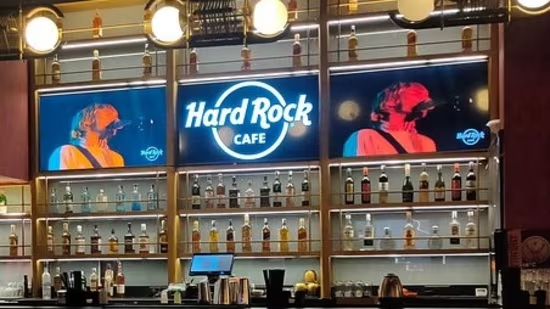
The iconic guitar-shaped neon sign that once lit up St. Mark’s Road in Bengaluru, Park Street in Kolkata, and Delhi’s vibrant dining hubs has gone dark. But the story of Hard Rock Cafe’s demise in India is far from straightforward – it is a strange tale of a terminated franchise agreement, a legal battle, and a brand caught between two warring companies.
After 21 years of rocking Indian cities, Hard Rock Cafe’s 10 outlets across the country shut down following Hard Rock International’s termination of its agreement with Indian franchisee JSM Corporation on March 16, 2026 . However, JSM Corporation has refused to accept the closure, calling it “unilateral, illegal and entirely misconceived,” and has indicated plans for legal action .
How it began and how it ended
Hard Rock Cafe first came to India in 2005, opening its inaugural outlet in Mumbai’s Worli neighborhood through a partnership with Sanjay Mahtani and Jay Singh’s JSM Corporation . Over the years, it expanded to major cities, becoming a cultural landmark for rock music lovers and a symbol of Western-style dining in urban India.
The chain’s Bengaluru outlet on St. Mark’s Road, spread across 9,000 square feet, became particularly iconic – a space where generations of music fans attended Pink Floyd tributes, Judas Priest covers, and performances by local and international bands .
In 2017, Jay Singh exited the company, and Bengaluru-based Embassy Group’s Managing Director Jitendra Virwani acquired a stake . But behind the scenes, tensions were brewing.
The termination: March 16, 2026
On March 16, Hard Rock International announced it had formally terminated its agreements with JSM Corporation and related entities, revoking their rights to operate all Hard Rock Cafes and Rock Shops in India . The affected outlets included locations in Bengaluru (three outlets), Chandigarh, Chennai, Hyderabad (two outlets), Kolkata, New Delhi, and Pune .
The company did not specify the reasons for termination, though industry sources cited factors such as rental payment defaults, declining profitability, and operational disagreements between the two companies .
The Hard Rock Hotel in Goa, operated by a different entity under a separate agreement, was confirmed to remain open .
The backlash and legal counterpunch
Just one day later, on March 17, JSM Corporation hit back. The Mumbai-based company expressed “deep shock” at Hard Rock’s announcement, stating that the claims were “outside the contractual framework” .
JSM revealed that it had made a “substantial monetary claim” against Hard Rock International, suggesting deeper financial disputes . The company declared that all Hard Rock Cafes in India would “continue to operate as usual pending any binding order of a court of appropriate jurisdiction to the contrary” .
Hard Rock International responded by thanking guests and fans for their “years of patronage” and clarifying that India remained an important market, though the statement offered no clarity on the brand’s future in the country .
Why the brand struggled
Even before the franchise war, Hard Rock Cafe was losing relevance. A consultant told Business Standard: “There are too many places like Hard Rock now that have a better lineup of performing bands, better food, and better crowds. It used to be exciting and fun, but it has lost its relevance” .
Social media reactions echoed this sentiment. One user commented: “The cafe was good but local pubs gave tough competition. Hard Rock Cafe was good but ultra expensive. Many local bars and cafes opened with same concept with way lesser price” .
Another noted: “Hard Rock Cafe was never meant to be just a place to eat, but a shared cultural experience around music. Indian franchise lived up to that idea partly in the beginning, but it drifted. Music became background, not identity. This was coming” .
The rise of microbreweries, gastropubs, and homegrown live music venues across India’s metro cities created an increasingly crowded market. Younger consumers, who once flocked to the brand for its Western appeal, began preferring local alternatives with better pricing and more curated music experiences.
The human cost
The sudden closures left hundreds of employees across the 10 outlets uncertain about their futures . For many, the cafe was not just a workplace but a community – a place where they had spent years serving generations of music fans.
Regular customers mourned the loss. Tejaswini Anjankumar, a fashion designer, told The Times of India: “This was the first truly ‘cool’ place I visited during my college days. For our generation, it was a big part of our social life” .
What lies ahead
The legal battle between Hard Rock International and JSM Corporation remains unresolved. If JSM’s legal challenge succeeds, the cafes could potentially reopen under the same management. If Hard Rock prevails, the brand may seek new franchise partners to re-enter the Indian market.
What is certain is that Hard Rock Cafe’s fate in India has become a cautionary tale about the perils of franchise relationships, the changing tastes of urban consumers, and the fragility of even the most iconic global brands when they lose touch with local markets.
For now, the guitar has fallen silent. But in India’s strange and evolving restaurant industry, this may not be the final chord.