


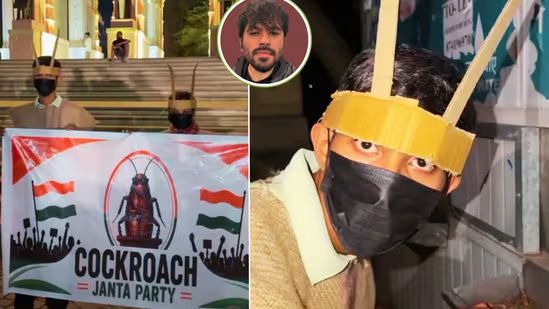
The ‘Cockroach Janta Party’ (CJP) refuses to be crushed. The satirical online movement, which exploded onto the digital scene last week following controversial remarks by Chief Justice Surya Kant, has escalated from memes and Instagram followers to real-world police action, high-voltage political rhetoric, and now, a petition in the Supreme Court.
What began as a joke about unemployment has crawled into the corridors of power—and the government is struggling to swat it away.
Security at founder’s home amid death threats
As the movement’s online popularity surged past 22 million followers on Instagram, its 30-year-old founder, Abhijeet Dipke, began receiving chilling threats. The situation became so grave that the Chhatrapati Sambhajinagar (Aurangabad) city police deployed a bandobast of 22 personnel and two officers outside his family’s residence in the Waluj MIDC area.
Police sources confirmed that Dipke had received explicit messages warning him of “dire consequences” targeting his parents. One threat read: “Delete your account and stop everything… even if you are in America, your parents are here in India.”
Deputy Commissioner of Police Pankaj Atulkar stated that the security is purely precautionary. “The bandobast has been deployed as a precautionary measure to ensure no adverse effect on Dipke’s family and to maintain peace in the area,” he said.
A crisis for the ruling alliance: Ally flags ‘concerns’
While the government initially moved to block the CJP’s main X account (citing national security threats from the Intelligence Bureau), the political fallout has now reached the ruling National Democratic Alliance (NDA).
In a significant development, a key BJP ally has reportedly expressed “serious concerns” over the handling of the situation and the social media clampdown. This dissent within the ruling coalition suggests that the “Cockroach” wave is causing friction in the highest echelons of power, even as leaders like Rajeev Chandrasekhar label the movement a “cross-border influence operation” involving AI and bots.
Opposition leaders, including Shashi Tharoor and Akhilesh Yadav, have rallied behind the movement, framing it as legitimate democratic expression.
The legal battle moves to the Supreme Court
As the digital crackdown intensified—with Dipke alleging that the party’s website was taken down and that even backup social media handles faced restrictions—the legal machinery began to stir.
A Public Interest Litigation (PIL) has been filed in the Supreme Court challenging the government’s decision to block the online content. The petition argues that the sweeping censorship violates Article 19(1)(a) (Freedom of Speech and Expression) and sets a dangerous precedent for punishing satire.
Rights groups, including Amnesty International India, have slammed the blocking order, calling it a “blatant misuse of state power” and an attempt to stifle dissent under vague national security claims.
‘You can’t get rid of us’
Despite the physical threats, the political heat, and the legal blocks, the movement shows no sign of stopping. Dipke remains defiant, operating from the US where he is pursuing a master’s degree.
“Cockroaches never die,” he posted recently, confirming the launch of a new digital home for the party after the previous domain was seized.
For the youth who have flooded the CJP’s ranks, the movement has become a symbol of resistance against establishment arrogance. From the streets of Bengaluru—where police denied permission for a proposed human chain—to the digital villages of small-town India, the “Cockroach” keeps up the crawl, leaving the establishment scrambling for a response.