


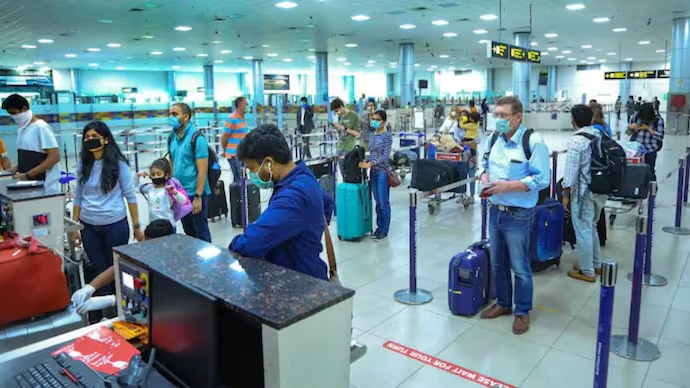
The Directorate General of Civil Aviation (DGCA) has issued a detailed Standard Operating Procedure (SOP) for public health preparedness and response to the Ebola virus, directing airlines to strengthen onboard surveillance and passenger screening measures at all Indian airports .
The directive comes after the World Health Organization (WHO) declared the Ebola outbreak caused by the Bundibugyo virus a Public Health Emergency of International Concern (PHEIC) .
Mandatory self-declaration forms for all passengers
Under the new guidelines, airlines have been instructed to ensure mandatory filing and collection of Self Declaration Forms (SDF) from all passengers originating from or transiting through Ebola-affected countries before de-boarding .
The DGCA has listed 13 airlines carrying passengers from the Democratic Republic of Congo (including Air India, IndiGo, Akasa Air, Emirates, Air France, Etihad Airways, and Egyptair) and 17 airlines carrying passengers from Uganda .
All travellers, including passengers and crew members irrespective of nationality, will be required to fill out these forms and submit them at designated immigration or health counters on arrival in India .
In-flight announcements and symptom reporting
The aviation regulator has made it compulsory for airlines to broadcast specific health announcements during flights to help identify possible Ebola cases early .
Passengers have been asked to immediately report symptoms such as fever, weakness, muscle pain, headache, sore throat, vomiting, diarrhoea, rash, or bleeding to airline crew members as well as immigration or medical authorities upon arrival .
The in-flight announcement states that early reporting is important for prompt diagnosis, treatment, and prevention of transmission .
Protocol for suspected cases on board
If a passenger displaying these symptoms is detected on board, strict containment procedures must be followed :
- Designate a single cabin crew member to exclusively care for the symptomatic passenger
- Relocate the passenger to the rear end of the aircraft
- Keep three rows in front and side rows of the suspected case vacant
- Designate a separate washroom for the suspect
- Provide the sick passenger with a mask and necessary Personal Protective Equipment
- Provide triple-layer masks to passengers seated in adjacent rows
The aircraft needs to be completely disinfected immediately after landing, and the Airport Health Organisation (APHO) team must be given details of the passenger and those seated nearby for 21-day monitoring .
Arrival protocols and airport screening
The DGCA has specified that for suspected cases, the aircraft should be parked in a separate, designated bay. All asymptomatic passengers shall de-board first, while the suspected case and designated caretaker must de-board last and be handed over directly to the health team .
Airports across India have intensified screening measures. Ahmedabad’s Sardar Vallabhbhai Patel International Airport has mandated that all international airlines complete health-related in-flight announcements and SDF filing before arrival to avoid crowding and minimise transmission risk .
Health workers have been deployed round the clock in arrival areas, and thermal screening is being conducted for international travellers .
Nationwide preparedness
Union Health Minister J.P. Nadda reviewed the country’s preparedness on May 25, confirming that no case of Ebola has been reported in India so far .
The Health Ministry has directed authorities to maintain strict Ebola screening arrangements at all points of entry, including airports, seaports, and land border crossings . The Indian Council of Medical Research (ICMR) and National Centre for Disease Control (NCDC) have been instructed to keep all testing and surveillance systems on constant alert .
What passengers should know
The DGCA has advised travellers that if Ebola-related symptoms develop within 21 days of arrival in India, they should immediately seek medical assistance at designated hospitals and inform airport health authorities .
Health authorities have urged passengers to cooperate fully with screening protocols. Officials have clarified that, under no circumstances, should health workers or passengers be exposed to the risk of infection .