


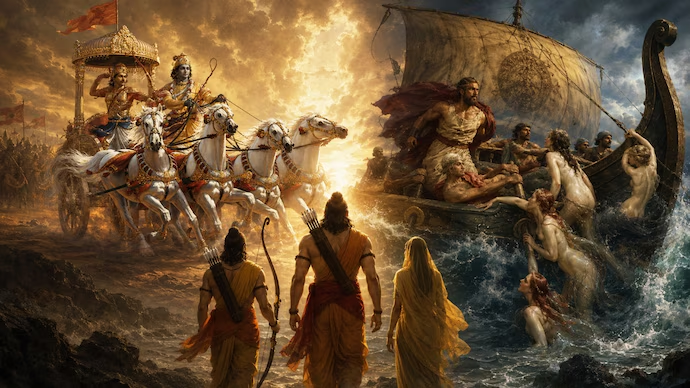
When Hollywood filmmaker Christopher Nolan’s next magnum opus, The Odyssey, reached cinemas, audiences stepped into a story that has travelled across nearly 3,000 years. Homer’s ancient Greek epic may belong to a different civilisation, but its tale of exile, war, supernatural forces and a long journey home may feel surprisingly familiar to Indian audiences raised on the Ramayana and the Mahabharata.
A hero separated from home. Years of exile. A dangerous journey filled with monsters and supernatural forces. Gods who intervene in human lives. A family waiting for a loved one to return. Sounds familiar, right?
These are some of the threads that run through The Odyssey, the Ramayana and the Mahabharata. The three epics are not the same, and there is no established evidence that Homer borrowed from Indian traditions. The Ramayana and Mahabharata are sacred epics that remain deeply connected to India’s religious and cultural traditions, while The Odyssey is a work of ancient Greek mythology and literature. They emerged from different civilisations and traditions. Yet, when placed side by side, their similarities are difficult to ignore.
The Long Journey Home
At the heart of all three epics is a journey shaped by separation. In The Odyssey, Odysseus, the king of Ithaca, spends 10 years fighting in the Trojan War before embarking on another decade-long journey home. In the Ramayana, Lord Rama is exiled from Ayodhya for 14 years. The Mahabharata gives us another version of exile—the Pandavas lose their kingdom in a rigged game of dice and are forced to spend years away from home. The circumstances are different, but the emotional idea is familiar: the hero is separated from home and must endure a long, difficult journey before returning to it.
The Hero Versus the Supernatural
The journeys in all three epics take their protagonists beyond the ordinary human world. Odysseus encounters the Cyclops, Scylla and Charybdis, the Sirens and Circe. Lord Rama faces Ravana and his formidable forces, while the Pandavas encounter rakshasas and other extraordinary beings during their years in the forest. The stories are not direct equivalents, but the narrative idea is familiar: a hero’s journey is repeatedly interrupted by forces beyond the ordinary human world.
Temptation as a Test
Odysseus’ journey is filled with temptation. The Lotus-Eaters offer forgetfulness. Circe keeps him and his men on her island. The Sirens use their voices to lure sailors towards destruction. The Ramayana also turns illusion and desire into important parts of its narrative. The golden deer, later revealed to be Maricha in disguise, sets in motion the chain of events that leads to Sita’s abduction. The Pandavas, meanwhile, face a different kind of temptation. Their exile is shaped by the consequences of a game of dice. The stories differ, but the question remains similar: Can the hero recognise the trap before it is too late?
Gods Who Guide and Gods Who Obstruct
The gods are never distant figures in these stories. Athena repeatedly helps Odysseus, while Poseidon works against him. In the Ramayana, divine forces are central to the larger story of Rama’s life and mission. In the Mahabharata, Lord Krishna’s guidance to Arjuna on the battlefield becomes one of the epic’s most important philosophical moments. But divine intervention does not make the journeys easy. The heroes must still face their choices and consequences.
The Family Waiting at Home
Perhaps the most emotional connection between the stories lies in the people left behind. Penelope waits for Odysseus for 20 years while fending off suitors. The Ramayana offers a different story of separation through Rama and Sita. In the Mahabharata, the idea of family is more complicated—the Pandavas’ exile affects not only the five brothers but Draupadi, Kunti and the larger Kuru family. The emotional details differ, but the underlying question remains: What does separation do to the people waiting for the hero to return?
The Absent King and the Threatened Kingdom
This is another striking parallel. Odysseus is away from Ithaca for years. In his absence, the suitors occupy his palace. Lord Rama’s exile creates a crisis in Ayodhya. Bharata refuses to take his place as king and waits for his brother’s return. The Pandavas lose their kingdom and spend years in exile before seeking to reclaim it. In all three stories, the hero’s return is tied not just to family but to the restoration of order.
Three Epics, One Timeless Journey Home
These are three different worlds with three different ideas of heroism. Three epics, one enduring question: what does it take to find your way home after exile, loss and war?
There is no established evidence that Homer directly borrowed from Indian traditions. But stories can still speak to one another across cultures. Long before cinema, ancient storytellers were already asking similar questions. What happens when a person is separated from home? How does one survive exile? What does duty demand? How does one resist temptation? And what does it mean to finally return?
That is perhaps why The Odyssey may feel strangely familiar to Indian audiences. Its gods are Greek, its monsters belong to Greek mythology and its landscapes stretch across the Aegean world. But its emotional architecture—exile, endurance, temptation, family, divine intervention and the longing for home—is universal.