


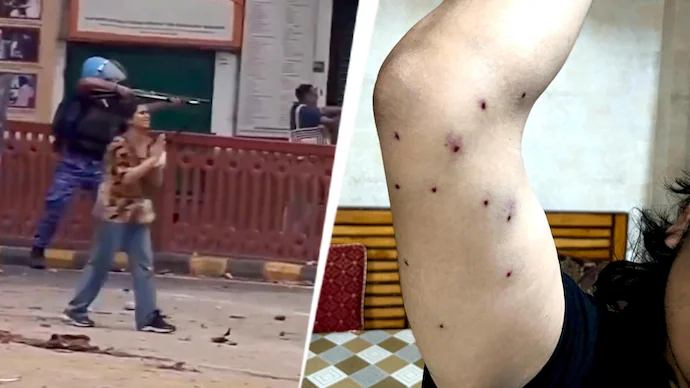
Three people, including a teenager and a journalist, were injured in what is reportedly the first known instance of pellet guns being used against civilians in the National Capital Territory
In the late afternoon of July 20, as thousands marched through the heart of Delhi, Rapid Action Force (RAF) personnel fired pellet guns at protesters. At least three people, one a teenager and two in their 20s, were hit. This was reportedly the first known instance of the use of pellet guns against civilians in the National Capital Territory.
A pellet lodged below the eye of one protester. Another protester was hit directly in the eye, arm and back. A third, a journalist, was hit while fleeing. The shots were fired in the open, in full public view, against an unarmed crowd.
Contrary to standard crowd-control protocol, water cannons were not deployed before police used tear gas and pellet guns.
The Victims
Shaikh Irshad Mansoori was near Palika Bazaar in Connaught Place when he was struck. Reports from The Hindu and The Indian Express suggest that Mansoori reached Lady Hardinge Hospital around 5 pm on July 20. Apart from the pellet that remained lodged below his eye, Mansoori also sustained facial injuries from the pellets.
Sahil Lochab was near Khadi Gramodyog Bhavan. He also reached Lady Hardinge around 5 pm with injuries to the eye, the side of the arm and his back.
The third victim, a journalist who has asked not to be named, was near The Statesman House at around 4 pm. He was hit while running after seeing a gun pointed at him. The pellet struck him on the back. He reached Safdarjung Hospital by about 4.30 pm.
Three Failures of Crowd Control
First, pellet guns are meant to be a last resort. Standard crowd-control sequencing begins with less-lethal options. Water cannons were available and were not deployed. The protesters were dry. No water barrier or high-pressure spray was used to create distance or disperse the gathering before “metal pellets” were fired.
The choice skipped intermediate measures and went straight to a weapon whose effects, at close range, are well documented as capable of causing permanent injury.
Second, the crowd, as seen in the videos, presented no imminent threat that would justify the immediate escalation. The incident occurred in open public space. There was no rioting, no visible weapons in the hands of the protesters. The journalist, who was hit with over 20 pellets, told India Today Digital that he was present only as an observer. He was running away when the pellet struck him on the back.
Third, the firing itself disregarded established protocols. Guidance on the use of pellet guns requires shots to be aimed below the waist and, where possible, the use of deflectors to direct the spray downward so that vital organs are protected. That did not happen. The three victims were hit on the face, eyes, torso and back. One pellet lodged below the eye. Another caused injury to the eye.
Legal and Operational Framework
Lawyer Vrinda Grover, speaking to India Today TV, set out the legal and operational framework that was ignored. “The state is responsible for the use of a weapon of this nature. There are strict guidelines as to when certain kinds of weapons are to be used. The nature of the crowd and the principles of necessity and proportionality, both in the use of force and choice of weapon at all times have to guide it.”
Grover also said, “It is undeniable nobody was armed. There were multiple other ways in which crowd control takes place. This [pellet gun] was used. The law says do not use metal pellets. The ones that are used here are metal pellets. This, when used in less than 500 metres, turns into a lethal weapon.”
The legal standard is necessity and proportionality. Necessity asks whether any force at all was required at that moment. Proportionality asks whether the chosen weapon and the manner of its use were the least harmful options available. On both counts, the sequence of events raises questions.
The RAF is a specialised unit of the CRPF, which has begun a probe into the use of pellet guns. A source confirmed to India Today TV that the RAF used a pellet gun in the Connaught Place area on July 20.