


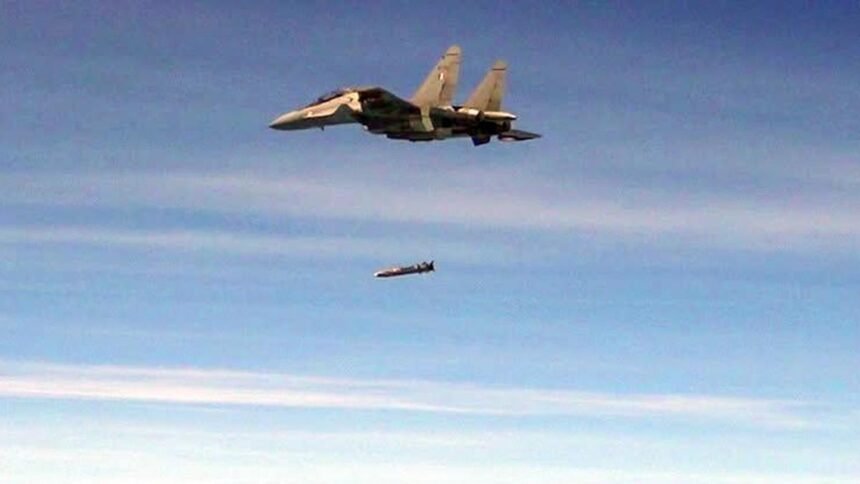
In a significant boost to India’s precision strike capabilities, the Defence Research and Development Organisation (DRDO) and the Indian Air Force (IAF) successfully conducted flight-tests of the indigenously-developed RudraM-II air-to-surface missile. The tests were carried out from a Sukhoi-30 MKI fighter jet off the coast of Odisha .
According to a statement from the Ministry of Defence, the missiles were released under “extreme release conditions,” following a critical trajectory that validated the performance of all onboard subsystems . After release, the missile demonstrated pinpoint accuracy, successfully engaging a predefined target .
Mach 5.5 Speed and Advanced Guidance
RudraM-II is a next-generation solid-propellant missile designed specifically for Suppression of Enemy Air Defences (SEAD) missions . It is capable of reaching a peak speed of Mach 5.5 and can strike targets at a stand-off range of approximately 300 km .
The missile carries a 200 kg warhead and utilizes a sophisticated hybrid guidance system. This includes an Inertial Navigation System (INS), GPS, and a passive homing seeker that can detect and lock onto radio frequency emissions from enemy radars across a wide frequency band .
Unlike older systems that lose their target if the radar is switched off, RudraM-II is designed to defeat such countermeasures. Its seeker suite enables it to continue its attack even if the enemy shuts down their air defence assets mid-flight .
Strategic Significance and Indigenous Development
The successful test marks a major milestone in India’s quest for self-reliance (Aatmanirbharta) in advanced weapon systems . RudraM-II is set to eventually replace the aging Russian-origin Kh-31 anti-radiation missiles currently in service with the IAF .
The missile has been developed by the Research Centre Imarat (RCI) in Hyderabad, in collaboration with several DRDO laboratories including the Defence Research and Development Laboratory (DRDL) and the High Energy Materials Research Laboratory (HEMRL) .
Defence Minister Rajnath Singh lauded the efforts of the DRDO and the IAF, stating that the tests demonstrate the growing maturity of indigenous defence technologies .
Enhanced Stand-off and Regional Context
With a range of 300 km, the RudraM-II offers a significant tactical advantage, allowing IAF fighter jets to engage enemy air defense systems from well outside their engagement zones . This stand-off capability is critical for suppressing enemy radar networks during the initial phases of an air campaign, paving the way for deeper strikes.
While the missile is currently integrated with the Su-30 MKI, plans are underway to integrate it with other frontline platforms, including the Tejas Mk-1A . Multiple flight tests have validated the missile’s performance across varying envelopes .