


The Supreme Court will on Wednesday deliver its verdict on a batch of petitions challenging the constitutional validity of the Election Commission of India’s (ECI) Special Intensive Revision (SIR) of electoral rolls — a judgment that will determine whether the country’s poll panel overstepped its constitutional mandate .
A bench of Chief Justice of India Surya Kant and Justice Joymalya Bagchi, which had reserved judgment on January 29 after nearly three months of hearings, is scheduled to pronounce the ruling at 10:30 am .
At the heart of the matter is a fundamental question: Can the Election Commission, under the guise of revising electoral rolls, effectively determine citizenship?
What is the SIR exercise?
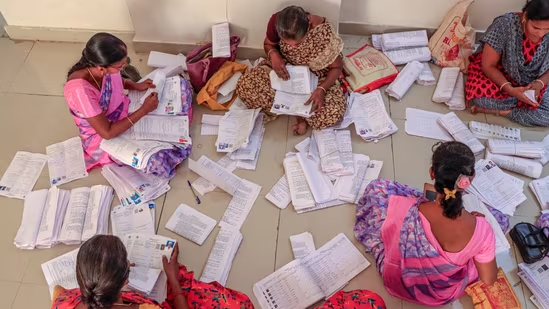
The SIR was first initiated in Bihar through a June 24, 2025 notification, requiring voters not traceable to the 2002 or 2003 electoral rolls to furnish documentary proof linking them to persons present in those “legacy rolls” . The exercise was subsequently extended to multiple states and Union Territories, including West Bengal, Tamil Nadu, Kerala, Uttar Pradesh, and Assam.
By the time West Bengal voted in April this year, over 9.1 million names, amounting to approximately 11.88% of the state’s pre-revision electorate of 76.6 million, had been deleted from the rolls . Data analyzed by civil society groups suggested that about 34.3% of deletions in West Bengal were Muslim voters, against a community share of roughly 27% .
The petitioners’ case: A ‘carte blanche’ on citizenship
The batch of petitions — filed by the Association for Democratic Reforms (ADR), People’s Union for Civil Liberties (PUCL), opposition MPs including Mahua Moitra, Manoj Jha, KC Venugopal, and political activist Yogendra Yadav — argues that the ECI has arbitrarily assumed powers to “determine citizenship” without any statutory backing .
“EC says its power to control elections under Article 324 is a carte blanche, not bound by any law, or rules, or any manual. EC says we can do what we want or how we want. But no authority can act arbitrarily or without any good reason,” advocate Prashant Bhushan submitted during the hearings .
The petitioners contend that the SIR exercise impermissibly shifted the burden of proof onto existing voters — reversing the settled legal presumption recognized in Lal Babu Hussein v. Electoral Registration Officer (1995), under which a person whose name already exists on the electoral roll is presumed to be an Indian citizen unless proven otherwise by the state .
They further argued that the SIR’s requirement of ancestral linkage to 2002/2003 rolls created a “suspended citizenship” regime, effectively disenfranchising millions of eligible voters, particularly migrant workers, women, and religious minorities .
The Election Commission’s defense
The ECI defended the exercise as a constitutionally mandated verification process necessary to ensure the “purity of electoral rolls” and prevent non-citizens from participating in elections .
Senior advocates Rakesh Dwivedi and Maninder Singh argued that the commission was merely verifying citizenship for electoral purposes and not determining citizenship in the legal sense — a power that constitutionally belongs to the Union government and Foreigners Tribunals under the Citizenship Act .
The commission also argued that the SIR was distinguishable from the Lal Babu Hussein precedent because the present process involved no police inquiry and provided administrative verification mechanisms through house-to-house enumeration by Booth Level Officers .
The ‘Logical Discrepancy’ controversy
A particularly contentious feature of the West Bengal SIR was the use of an undocumented “logical discrepancy” (LD) software classifier that flagged voters for parental-name spelling mismatches, parent-child age-gap anomalies, or “more than six children” . Of roughly 60 lakh cases routed for adjudication, 27.1 lakh (45%) were ultimately deleted.
“The constitutional difficulty is not that algorithms have been deployed; it is that an undocumented classifier has produced 1.2 to 1.36 crore ex ante suspects whose status is then resolved through proceedings notionally compliant with natural justice, but operationally driven by the algorithmic flag,” a detailed analysis by the ADR noted .
Court intervention and interim safeguards
While the Supreme Court refused to stay the SIR process, it effectively intervened to make the exercise more inclusive through a series of interim orders under Article 142 of the Constitution .
Key interventions included:
- Directing the inclusion of Aadhaar as the 12th acceptable document, expanding the original list of 11
- Emphasizing that the objective must be “mass inclusion, not en masse exclusion”
- Requiring publication of district-wise, booth-level searchable lists of deleted voters with exact reasons
- Deploying approximately 700 judicial officers in West Bengal to adjudicate LD claims
- Constituting 19 Appellate Tribunals chaired by retired High Court judges to hear deletion appeals
The larger constitutional question
Beyond the immediate challenge to the SIR, the verdict is expected to settle a long-standing doctrinal debate: whether the right to be registered as a voter is merely statutory — as held in Kuldip Nayar v. Union of India (2006) — or whether it carries constitutional protection under Articles 14, 19, and 21, as indicated in subsequent decisions such as PUCL v. Union of India (2003) and Anoop Baranwal v. Union of India (2023) .
The outcome will have profound implications. If the court upholds the SIR, it will affirm the ECI’s expansive powers to revise rolls in the name of electoral purity. If it strikes down the exercise, it will reaffirm that the right to vote — and to be registered as a voter — cannot be abridged without clear statutory authority and robust procedural safeguards .