


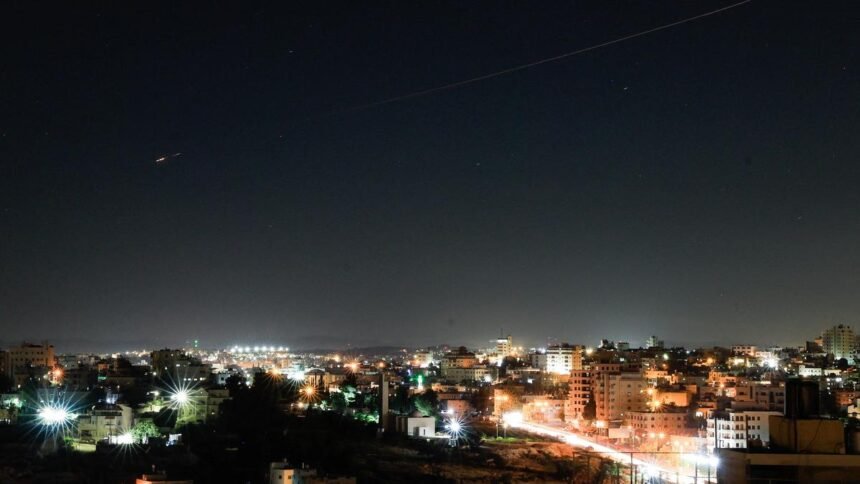
Iran launched multiple waves of missiles toward northern Israel on Sunday evening, marking the first direct Iranian bombardment of Israeli territory since a fragile ceasefire was established in early April .
The Israeli military confirmed that all projectiles were intercepted by air defense systems. There were no immediate reports of injuries or significant damage .
Four waves of missiles
Israel’s military reported that Iran fired four missile barrages toward the country. Air raid sirens sounded across northern Israel, with initial reports indicating damage in the city of Tiberias from falling debris .
The Iran-backed Islamic Revolutionary Guard Corps (IRGC) confirmed the attack, stating it targeted Israel’s Ramat David Airbase with ballistic missiles. The IRGC warned that “this operation is not a passing event, but rather the beginning of a full week of continuous strikes,” threatening to launch waves of missiles and drones around the clock for the next seven days .
Trigger: Israeli strike on Beirut
The Iranian missile attack came hours after Israel carried out airstrikes on Beirut’s southern suburbs, a Hezbollah stronghold. Lebanon’s Public Health Emergency Operations Center reported that the Israeli strike killed at least two people and injured 20 others .
Iran had previously warned that it would retaliate against any Israeli attack on Lebanese territory. Earlier Sunday, Iranian Parliament Speaker Mohammad Bagher Ghalibaf vowed to “halt the negotiation process” and “engage in direct confrontation with the enemy” if Israeli attacks against Lebanon continued .
Israel vows response
The Israel Defense Forces (IDF) said Iran had made a “grave mistake” by launching the attack. IDF Chief of Staff Eyal Zamir stated that the military “will strike the enemy with determination as soon as the order is given” .
Following the attack, Israel’s Home Front Command tightened civil defense restrictions nationwide, banning open-air gatherings of more than 200 people. Indoor gatherings were limited to 500 people in venues with protected spaces, while schools and beaches were closed . Ben Gurion Airport near Tel Aviv suspended operations temporarily .
Trump urges restraint
U.S. President Donald Trump responded to the escalation by urging Iran to stop its missile attacks and return to the negotiating table. In an interview with Fox News, Trump said: “This attack does not help negotiations.” He also called on Israel to exercise restraint, noting that “no one was hurt” and expressing hope that Israel would refrain from retaliating .
Trump stated that he would personally call Israeli Prime Minister Benjamin Netanyahu to urge against retaliation, maintaining that a deal with Iran remains close. “We are very close to a final agreement with Iran, and I do not want this to fall apart because of what is happening now,” he said .
Fragile ceasefire unraveling
The April ceasefire between Iran, Israel, and the U.S., which had been brokered by Pakistan, had already been strained by continued Israeli strikes on Lebanon. Iran has consistently insisted that the ceasefire must include an end to fighting in Lebanon, a position Israel has rejected .
The escalation raises critical questions about whether Israel will retaliate. Israeli officials have indicated that the country will “not allow the equation Iran is attempting to create,” and a significant response is expected . However, the limited nature of the attack—with no casualties and all missiles intercepted—could influence the scale of any Israeli response .
As one analyst noted, Iran has made good on its threat, but much now depends on Israel’s next move. A new round of tit-for-tat attacks could reignite the broader Iran war, while restraint could allow diplomatic efforts to resume .