


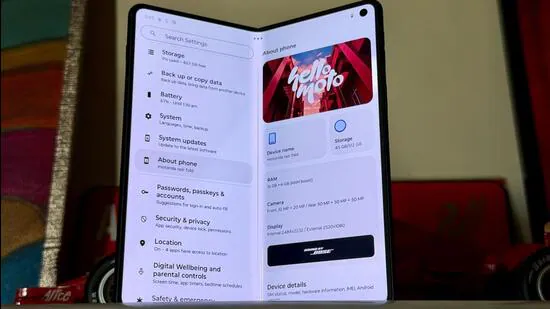
For years, the book-style foldable market has been a two-horse race dominated by Samsung and Google. Motorola, despite ruling the flip-style (clamshell) segment, stayed conspicuously absent from the large-screen party. That changed on May 13, 2026, when Motorola launched its first-ever book-style foldable, the Motorola Razr Fold, in India .
The device enters a crowded field. It will go up against the established Samsung Galaxy Z Fold 7, the Google Pixel 10 Pro Fold, and the Vivo X Fold 5 . But with a price tag starting at ₹1,49,999, does it merely participate in the premium segment, or does it genuinely intend to “change the foldable hierarchy” as the title suggests? Based on early reviews, the answer is: It has the hardware to try, but the software polish and value proposition might hold it back .
A massive battery and powerhouse specs
Motorola hasn’t held back on the physical hardware. At the core of the Razr Fold is the Snapdragon 8 Gen 5 chipset, built on a 3nm architecture, promising flagship-level speeds and AI capabilities .
However, the standout feature is the 6,000 mAh silicon-carbon battery. This is significantly larger than the 4,400 mAh cell found in the Samsung Galaxy Z Fold 7 . In early testing, reviewers noted that this battery “effortlessly powers through heavy use” . It supports 80W wired TurboPower charging and 50W wireless charging, though the fastest charging requires a proprietary brick sold separately .
Camera credentials and displays
Motorola claims the Razr Fold offers the “world’s best foldable camera system,” a bold statement backed by a DXOMARK Gold Label . The hardware includes a triple 50MP rear setup: a Sony LYTIA 828 main sensor, a 50MP periscope telephoto (3x optical zoom), and a 50MP ultrawide lens . Reviews have noted that pictures are “consistently vibrant and detailed,” though the colors tend towards a saturated, punchy look rather than natural tones .
On the front, users are treated to a 6.6-inch cover display (165Hz refresh rate) and an 8.1-inch LTPO main display (120Hz) with peak brightness reaching 6,500 nits . While the inner display has a visible crease, reviewers note it is “practically invisible” during use .
The stylus edge and the price problem
One significant advantage Motorola holds over its main rival, the Samsung Galaxy Z Fold 7, is stylus support. Samsung dropped S Pen support to make the Z Fold 7 thinner . Motorola supports the Moto Pen Ultra stylus, bridging the productivity gap for artists and note-takers, though the pen is sold separately .
However, the initial reception has highlighted two major hurdles.
Firstly, the software. While the hardware impresses, the software feels less refined. Reviewers have pointed out “limited split-screen options” and a lack of flexible app resizing, which hampers multitasking compared to Samsung’s One UI .
Secondly, the price. At $1,900 in the US (and ₹1.5 lakh in India), the Razr Fold is expensive . The Galaxy Z Fold 7, despite being a year older, often feels like a more complete package. Tech reviewers have noted that while the Razr Fold is a “solid foldable phone that doesn’t have anything catastrophically wrong with it,” it is “noticeably heavier” and struggles to “stand out against the competition” given the high price .
Verdict: A strong first move
Motorola has proven it can build a stunning piece of hardware. The battery life and camera specs put rivals on notice. But to truly “change the hierarchy,” Motorola needs software updates to unlock the multitasking potential of the large screen.
Until then, the Motorola Razr Fold is best described as a brilliant first attempt that signals Motorola’s ambition—but one that hasn’t yet dethroned the king.