

When the FIFA World Cup kicks off across the United States, Canada and Mexico next month, India will not be among the 48 competing nations. The country has never qualified for the tournament. Its men’s team languishes at 136th in the FIFA rankings.
And yet, according to a recent YouGov survey, 54% of Indians plan to follow the 2026 World Cup—the highest percentage of any country surveyed, well above the global average of 42% .
How does a nation that barely registers on the football map generate such staggering interest? The answer lies in Kerala, West Bengal, Goa, Manipur and the Northeast—pockets of the country where football is not a sport but a religion.
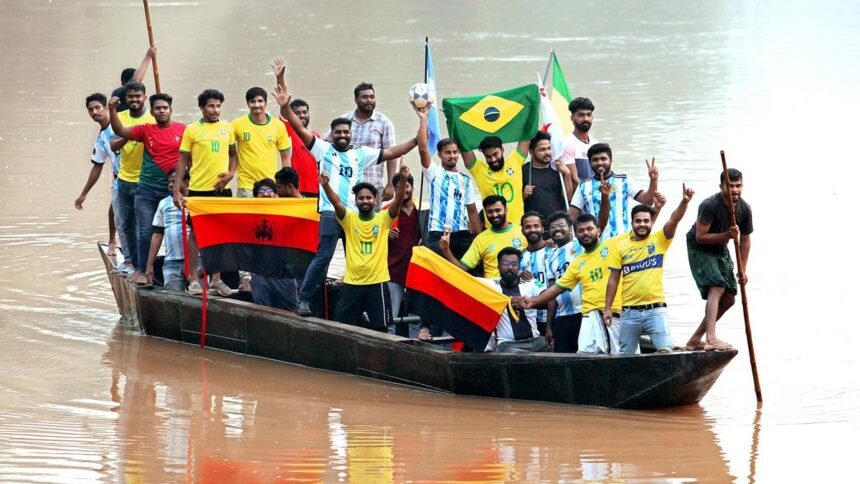
The Brazilian and Argentine flags of Kerala
For decades, Kerala has had an inexplicable, obsessive love affair with Latin American football. Walk through any town in Malabar during the World Cup, and you will find Argentine and Brazilian flags hanging from balconies, auto-rickshaws, and even tea stalls.
“People in Kerala know the flags of countries they could not locate on a map. They know the history, the players, the politics—all through football,” says K.M. Narendran, former journalist with All India Radio .
The phenomenon is not recent. It dates back to the days of Pelé, Maradona, and the limited television exposure of the 1980s and 1990s. Political and anti-establishment sentiments, however romanticised, steered Malayali fans toward Brazil and Argentina—nations seen as rebellious, passionate, and far removed from colonial powers.
84 million viewers, zero qualified players
Despite the national team‘s absence, India has consistently ranked among the top 10 countries in global World Cup television viewership. Nearly 84 million Indians watched the 2022 World Cup on television, with the final alone drawing 32 million viewers on JioCinema .
In total, 745 million Indians engaged with the tournament across all platforms in 2022—second only to China . That is not a niche audience. That is a mainstream cultural event.
And the numbers are expected to hold steady in 2026, even as the time zone difference threatens to disrupt viewing habits. Only 14 of the 104 matches will begin before midnight Indian time, with the final scheduled for a 12:30 AM kick-off .
Fan clubs, midnight screenings and cutouts
In Kozhikode, a local collective called Janakiya Samidhi, Puthiyapalam is building a screening gallery with a seating capacity of over 2,000 for the third consecutive World Cup. Funds have been raised through calendar sales, chit funds—and even the sale of firecrackers during Vishu .
Across the state, jersey replicas priced between ₹250 and ₹400 are flying off the racks. Electronics stores are bracing for a surge in television upgrades. Hair salons are fielding requests for Cristiano Ronaldo and Lionel Messi hairstyles .
“Messi is the most in-demand shirt, though Ronaldo is not far behind,” a sporting goods shop worker in Kozhikode confirmed. The “Messi economy”—the unofficial financial frenzy surrounding the Argentine superstar—is preparing to kick into gear .
The broadcast crisis: Can India watch?
There is, however, a looming crisis. With less than two weeks to go, FIFA has not yet secured a broadcast partner in India. Prasar Bharati has told the Delhi High Court that acquiring the rights is “not its responsibility,“ leaving millions of fans uncertain about where—or if—they will be able to watch the tournament .
The sticking point appears to be price. FIFA initially sought approximately $100 million for the Indian rights, but broadcasters have balked at the figure given the unfavourable time zone . The IPL, by contrast, regularly crosses a billion screens and commands premium advertising dollars.
For now, fans are preparing as if the deal will materialise. Those who remain less optimistic have their contingency plans: unofficial streams, global feeds, and the time-tested resilience of Indian football supporters who have never let official channels stand in the way of their passion.
Football as escape
In Manipur, where ethnic violence and political uncertainty have disrupted everyday life for years, football remains one of the few shared spaces of collective emotion. “People are crazy for football in Manipur,“ says former Indian midfielder Renedy Singh. ”Even though tensions remain high, people will still turn up for screenings“ .
In Kolkata, still reeling from election-related violence, actor Durbar Sharma notes that the flags of political parties will soon give way to those of Brazil and Argentina .
The most passionate fans
India may never qualify for the World Cup. Its players may never step onto that pitch. But when Argentina plays, when Brazil dances, when a last-minute goal sends a billion hearts racing—India will be watching.
And perhaps that is the definition of passion: loving a game that may never love you back.