


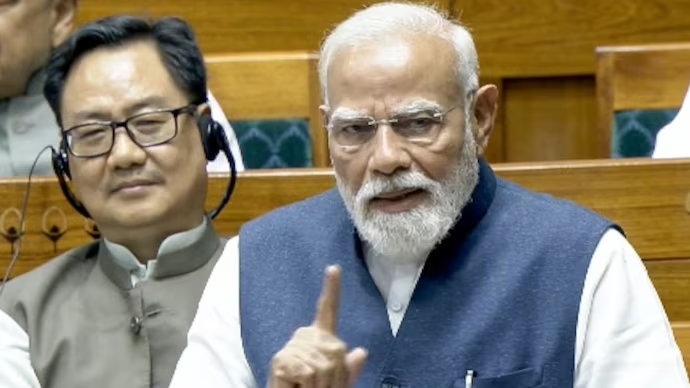
Prime Minister Narendra Modi, in Parliament on April 16, described women’s reservation as a correction delayed by decades but one that has finally arrived at a historic moment in India’s parliamentary journey.
Modi’s speech was delivered during the special session of Parliament convened to consider a package of constitutional amendments focused on operationalising the 33 per cent reservation for women in the Lok Sabha and legislative assemblies, alongside the structurally significant process of delimitation that will redraw parliamentary and assembly seats based on the next census cycle.
The Dual Argument
| Moral Urgency | Women’s reservation as a long-overdue correction and matter of constitutional justice |
| Institutional Framework | Linked to census and delimitation, controlling the timeline of implementation |
What stood out in Modi’s speech was the dual structure of his argument. On one hand, he invoked moral urgency. On the other, he embedded the reform within a highly technical institutional framework involving the census and delimitation.
Key Quotes from PM Modi
| “Women’s reservation should have been implemented three decades ago.” | Positioning as a long-overdue correction |
| “Nari Shakti will be watching not only the decision but also the intent.” | Signaling women as a politically responsive constituency |
| “No political party had opposed women’s reservation in principle.” | Recasting opposition as technical hesitation |
The Grassroots Foundation
Modi emphasised that women’s participation in governance was already deeply embedded in India’s democratic system through panchayati raj institutions and urban local bodies.
Government data suggests that women occupy a substantial share of elected positions at the grassroots, forming one of the largest pools of elected women leaders globally.
This argument serves a clear political function: it reduces ideological resistance by pitching women’s reservation in Parliament and state assemblies as a natural extension of an already-functioning system of local representation.
The Strategic Link to Delimitation
| What is Delimitation | Redrawing constituency boundaries based on updated population data |
| How It Links | Becomes the mechanism through which both representation and reservation will be operationalised |
| Purpose | Ensures the reform is not merely constitutional in intent but also demographic and structural in execution |
By linking the implementation to census and delimitation, the reform is placed within a wider structural timeline that extends beyond immediate parliamentary cycles.
Opposition Concerns
Some parties questioned whether linking women’s reservation to delimitation could:
- Delay implementation
- Alter the federal balance of representation across states
The government defended the linkage as necessary for ensuring equitable and data-driven implementation.
The Political Calculus
| Implementation challenges or delays will be closely associated with Modi’s leadership | Long-term narrative ownership of a consequential change in India’s representative system |
| Increases short-term political exposure | Strengthens his legacy as a reformer |
Modi did not simply advocate a legislative change. He centralised ownership of a long-horizon structural reform. By repeatedly stressing delay, invoking moral correction, and emphasising inevitability, he placed significant political equity behind the reform.
The Bottom Line
In totality, Modi’s speech reflects a convergence of moral argument, institutional design, and electoral strategy. Women’s reservation is being framed not as an isolated policy decision but as a broader restructuring of representation in India.
The political logic is twofold:
- To make the reform appear historically inevitable
- To make it institutionally irreversible
That is why the intervention is best understood not as a standalone parliamentary speech but as a moment where political narrative, legislative architecture, and long-term electoral design are being aligned into a single framework of change.