

The announcement of a peace deal between the United States and Iran, ending a 107-day conflict, has brought a wave of relief to the Indian economy. For a nation that imports over 88% of its crude oil and relies heavily on West Asian trade, the cessation of hostilities and the reopening of the Strait of Hormuz directly translate into lower fuel prices, a stronger rupee, and a significant drop in inflation risks .
Immediate Relief for the Energy Sector
The most immediate impact is on global energy markets. Following the announcement, Brent crude futures fell over 4% to around $83 per barrel . For India, this is a critical development, as every $10 increase in the average price of crude oil adds approximately $13-14 billion to the import bill and widens the current account deficit .
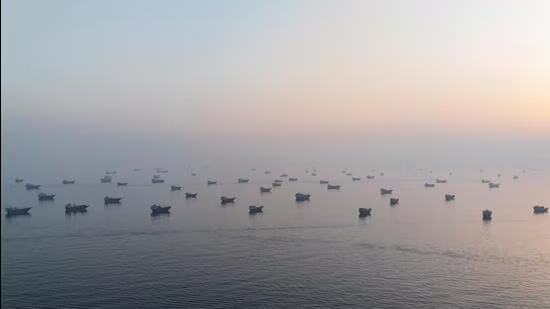
While India had diversified its crude sources, the Strait of Hormuz remained a vital chokepoint. It accounted for about 41% of India’s crude oil imports, 55% of its LNG imports, and a staggering 88% of its LPG imports . The reopening eases pressure not only on crude but also on LPG supply chains, freight rates, and shipping insurance, which had skyrocketed during the conflict .
Rupee and Inflation to Stabilise
The economic pain of the war was felt directly by Indian consumers and businesses. The disruption caused the rupee to hit record lows as dollar demand spiked, and inflation remained elevated due to higher food and energy costs . Experts from the think tank GTRI noted that the agreement promises relief from the high energy prices and inflation risks that intensified during the conflict .
With crude prices cooling, oil companies require fewer dollars for imports. This reduces pressure on the rupee, which is expected to strengthen in the coming weeks. Concurrently, India’s 10-year benchmark bond yield has already eased, and foreign investors have begun buying into Indian bonds again .
For the common citizen, the deal is expected to lead to a reduction in fuel prices, offering relief from the high transportation and cooking gas costs (LPG) that had strained household budgets .
Trade and Export Revival
The war had a crippling effect on India’s trade with the Gulf region. India’s exports to West Asia fell by nearly 58% in March alone, while imports fell by 52% . The reopening of shipping lanes is expected to normalise the movement of goods, lower insurance premiums, and cut delivery times, which had doubled as ships were forced to take the longer Cape of Good Hope route .
Federation of Indian Export Organisations (FIEO) President S C Ralhan stated that the easing of tensions would create a “more conducive environment for trade and economic growth,” helping India recover lost ground in key markets like the UAE and Saudi Arabia .
Strategic Gains: Chabahar Port and INSTC
Beyond immediate economics, the peace deal unlocks India’s long-term strategic investments in the region. The Chabahar Port in Iran, developed by India, serves as a crucial gateway to Afghanistan and Central Asia, bypassing Pakistan .
The war effectively grounded India’s ambitions at Chabahar after a US sanctions waiver expired. However, a stable peace deal could revive the International North-South Transport Corridor (INSTC), a multi-modal route linking India to Russia and Europe via Iran, making it commercially viable .
Outlook: Long-term Opportunities
The agreement, set to be signed in Switzerland on June 19, also opens the door for the return of Iranian crude to Indian refineries. This would give India greater bargaining power with other major suppliers like Russia, Saudi Arabia, and Iraq .
While significant hurdles remain—such as the fine print on frozen assets of $25 billion and the verification of Iran’s nuclear commitments—the immediate sentiment is overwhelmingly positive. Analysts believe the next 2-3 years could see accelerated growth for India, easing the path towards the goal of a Viksit Bharat (Developed India) .