

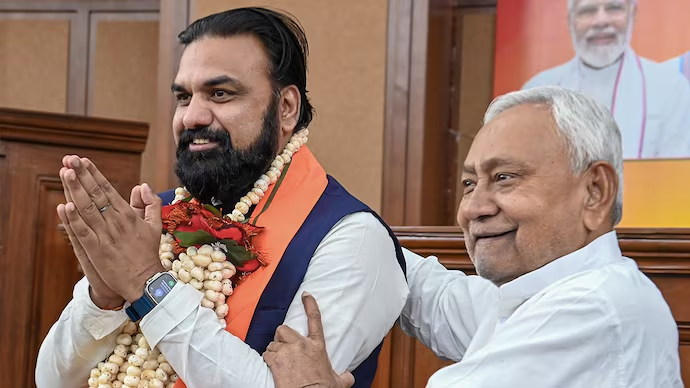
Power in Bihar rarely shifts cleanly; it is negotiated, layered and freighted with memory. Samrat Choudhary’s elevation as leader of the BJP Legislature Party on April 14, and expected swearing in as Bihar’s next chief minister, belongs to that tradition, even as it breaks from it.
For the first time, the BJP is poised to place its own chief minister at the helm of a state where it has long governed in the shadow of an ally.
A Historic First
| Event | Samrat Choudhary elected leader of BJP Legislature Party |
| Date | April 14, 2026 |
| Significance | First BJP chief minister of Bihar |
| Outgoing CM | Nitish Kumar (JD-U) |
Choudhary’s brief note of gratitude to Prime Minister Narendra Modi and BJP president Nitin Nabin sits in contrast to the magnitude of the moment: this is both a personal culmination and an institutional assertion.
The Man: A Political Journey Across Formations
| 1999 | RJD | Entered public life; ministerial stint in Rabri Devi government (cut short) |
| 2010 | RJD | Won election despite party’s lowest-ever tally (22 seats) |
| 2014 | JD(U) | Crossed over; became MLC and minister in Jitan Ram Manjhi government |
| June 2017 | BJP | Moved to BJP |
| March 2023 | BJP | Appointed Bihar state president |
| April 2026 | BJP | Set to become first BJP CM of Bihar |
Choudhary is not a leader who cut his political teeth in the BJP. His career has unfolded across formations, each shift sharpening his political instincts. The son of veteran politician Shakuni Choudhary, he entered public life through the RJD in 1999.
His first ministerial stint in the Rabri Devi government ended abruptly after questions over his age forced his exit. It was an early lesson in the unforgiving nature of public scrutiny.
The Nitish Factor
One of the reported conditions for Nitish Kumar agreeing to step down was that he would be allowed to choose his successor from within the BJP. His decision to back Choudhary is therefore a political endorsement shaped by both trust and arithmetic.
There is an irony embedded in Choudhary’s ascent. He was once among the sharpest critics of Nitish, particularly during the period from August 2022 to January 2024, when Nitish governed with the RJD. His attacks were unsparing, positioning him as a principal adversary rather than a future partner. That he would later secure Nitish’s confidence speaks of a different skill: the ability to recalibrate without appearing diminished.
The Arithmetic: Kushwaha Representation
| Community | Kushwaha |
| Population Share | Over 4% of Bihar’s population |
| Political Axis | Luv-Kush (Kurmi-Kushwaha) – Nitish’s traditional support base |
The arithmetic is central to understanding Choudhary’s utility. As a Kushwaha leader, he represents a community that constitutes over 4 per cent of Bihar’s population and forms a key part of the Luv-Kush (Kurmi-Kushwaha) axis that has historically anchored Nitish’s support. For the BJP, his elevation is a way to inherit that social coalition while imprinting it with its own leadership.
The Challenge Ahead
| Ideological Core | Saffron aspirations and Hindutva politics |
| Nitish’s Legacy | Caste balance, welfare distribution, administrative moderation |
The office he is set to assume comes with contradictions that cannot be easily managed. As Bihar’s first BJP chief minister, Choudhary will be expected to give expression to the party’s ideological core—its saffron aspirations and the idiom of Hindutva politics that animate its national identity.
At the same time, he inherits a state shaped by Nitish’s more calibrated social agenda, one that emphasised caste balance, welfare distribution and administrative moderation. Reconciling these impulses—assertion and accommodation, ideology and governance—will be his central test.
The Verdict
Choudhary’s political life has been defined by movement: across parties, across roles, across narratives. From an RJD minister navigating early controversy to a JD(U) functionary, and then to a BJP leader rising with unusual speed, his trajectory mirrors the fluidity of Bihar’s politics itself.
Whether Choudhary becomes a bridge between Bihar’s past alignments and its emerging political grammar, or merely a figure shaped by them, will depend on how he inhabits that tension.