


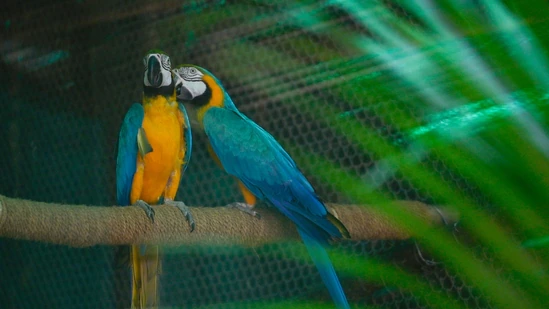
In a peculiar quest reminiscent of a dating show, the National Zoological Park (NZP) in Delhi is on the lookout for partners for at least 16 animal and bird species. These include a lonely nine-year-old female rhea, a male Indian grey hornbill who has been single for nearly a decade, and a solitary 18-year-old female rhinoceros .
The zoo has currently identified 20 “single” animals and birds that are either living alone or in same-sex groups, leading to zero breeding and raising welfare concerns. Zoo Director Sanjeet Kumar confirmed that multiple exchange programmes are currently at different stages of discussion with zoos across the country .
The lonely hearts club
Among the most urgent cases is the zoo’s pair of male ostriches, both aged around seven to eight years, who have lived without female companionship since their arrival from Chhatbir Zoo in 2021. A previous exchange to bring them partners never materialised .
Other “singles” include:
- A nine-year-old female rhea that has been at the zoo since 2018
- A male Egyptian vulture aged over 20 years
- A male Indian grey hornbill around 10 years old
- A 15-year-old male grey langur
- A lone male small Indian civet
- A single male black swan
- An 18-year-old female rhinoceros whose male partner died last year
The black bear population now comprises four females after the death of the only male bear in 2024. Even among the females, two are fairly old, and one has impaired vision .
Why pairing matters
Experts say animals in captivity tend to get restless and exhibit behavioural changes in the absence of companions. “Animals without companions are prone to stress. They may exhibit violent behaviour as they are unable to socialise,” said Renu Nair, a wildlife expert, in a previous interview .
Central Zoo Authority (CZA) guidelines explicitly recommend that zoological parks should not keep single animals for more than six months and must make arrangements for procuring viable partners .
Delhi Zoo Director Sanjeet Kumar emphasised that the prime focus is on pairing single-sex animals while also infusing fresh bloodlines. “If animals remain within the same closed group without periodic transfers, the risk of genetic disorders, weak offspring and infertility increases over time,” he said .
Exchange programme in motion
The zoo is currently in discussions with Mahendra Chaudhary Zoological Park at Chhatbir (Punjab), Bhagwan Birsa Biological Park (Ranchi), Rohtak Zoo (Haryana), and Kanan Pendari Zoological Garden (Bilaspur, Chhattisgarh) .
Under similar exchange programmes in the recent past, the zoo has received smooth-coated otters from Surat and a male tiger from Patna, while sending surplus animals including Sangai deer and painted storks to other facilities .
Officials said that while some efforts to bring in partners have previously failed to materialise, they are now taking a more proactive approach to help these species find companions sooner .
Not just breeding
Beyond reproduction, animal exchanges serve a critical purpose—maintaining the psychological well-being of captive animals. A 2024 report highlighted the case of Shankar, a lone African elephant who spent over a decade in isolation after his companion Vimbai died in 2001. The zoo eventually arranged to bring two female elephants from Africa as companions, partly due to international pressure over animal welfare concerns .
The zoo is also seeking female partners for a male barn owl that has remained alone since 2022, a male grey francolin, a male black francolin, a male spoonbill, and a male Indian civet. Male partners are being sought for a lone female porcupine, a female blue-winged macaw, and the remaining female bar-headed geese .
With the Central Zoo Authority actively facilitating these exchanges, there is hope that Delhi’s “wild singles” may finally find their match — boosting breeding, genetic diversity, and the overall well-being of the animals.